

What Is Hojicha? Caffeine, Taste and How to Make a Latte
Hojicha is roasted Japanese green tea. I explain where its brown colour comes from, what is really known about its caffeine, and how to make a latte at home in one minute.
Quick answer
Hojicha is a roasted Japanese green tea: the leaves and stems are heated until they turn from green to brown. It contains caffeine, usually less than matcha, because it is made from more mature leaves and stems. As a powder, 2 g is enough for a latte: a shot of hot water, then the milk.
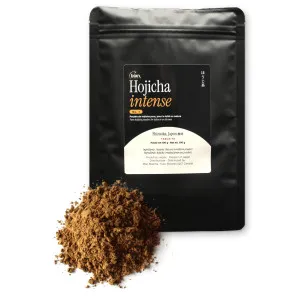 Your low-caffeine latteHojicha powderHojicha Intense No.1, a low-caffeine roasted green tea powder from Shizuoka with caramel notes: ideal in a latte in the afternoon or evening. 100 g pouch, about 50 lattes.$32.90 · See the hojicha →
Until now, I only sold matcha. For my second tea, I chose hojicha: among Japanese teas, it is the one Canadians search for most on Google after matcha, about 14,800 times a month, and you prepare it exactly the same way. Here is what I learned while choosing it.
What is hojicha?
Hojicha (ほうじ茶) is a roasted Japanese green tea: after harvest, the leaves and stems are heated until they turn from green to brown. It is still green tea, from the same plant as matcha, but roasting changes its colour and its aroma. Its name actually means “roasted tea” in Japanese.
It is most often made from more mature leaves, picked after the spring harvest, and from stems. Matcha, on the other hand, comes from the youngest leaves, grown in the shade, then ground without ever being roasted: I explain it in how matcha is made. For the two teas side by side (flavour, caffeine, uses), I wrote a separate guide: matcha or hojicha.
Mine, Hojicha Intense No.1, comes from Shizuoka, Japan's great tea region, which has about 35% of the country's tea fields. It is made mostly from stems and leaves of the 2nd and 3rd harvests, from the Yabukita cultivar, then roasted strong, hence its name.
| At a glance | Hojicha | Matcha |
|---|---|---|
| Leaves | More mature leaves and stems | Young, shade-grown leaves |
| Processing | Roasted, then ground for the powder | Steamed, dried, then ground, never roasted |
| Colour | Brown | Vivid green |
| Caffeine | Usually less than matcha | About 65 mg on average for 2 g |
| When | Afternoon, early evening | Morning, energy for the day |
| At Bian Matcha | Hojicha Intense No.1 | Barista No.1 for lattes, Ceremonial No.1 straight, also great in a latte |
| Cost of 2 g of powder | $0.66 | $1.06 |
If you want to try hojicha at home, here is the one I chose: a pure powder, with no sugar and no milk powder, strongly roasted, that you prepare in the Mini Shaker just like my matcha.

$10 shipping, free from $80 · ships within Canada
14-day money-back guarantee
What does hojicha taste like?
Hojicha is most often described as a tea with a toasty, rounded taste, far from the grassy side of a classic green tea: the roast takes over. The stronger the roast, the more that toasty side comes through.
Mine is strongly roasted, hence the name “intense”, with caramel notes. In a latte, the milk softens it; if you find it too strong, use a little less powder or a little more milk. And even though it is brown and roasted, hojicha does not taste like coffee: it is still a tea.
How much caffeine is in hojicha?
Hojicha contains caffeine, like any green tea, but usually less than matcha: it is made from more mature leaves and stems, while matcha comes from the youngest leaves. A study on fresh tea leaves showed it clearly: old leaves contain less caffeine than young ones (Lin et al., 2003).
For comparison, matcha's caffeine is well measured. On average, 2 g of matcha contains about 65 mg of caffeine, with most matcha analyzed falling between 30 and 90 mg (Standard Tables of Food Composition in Japan, 2020, and published studies). I go through these numbers in how much caffeine is in matcha.
For hojicha powder, I found no published analysis solid enough to give you a number: its content depends mostly on what is roasted, stems or young leaves. So I would rather not make one up.
A useful benchmark: Health Canada recommends a maximum of 400 mg of caffeine per day for adults, and 300 mg for people who are pregnant, breastfeeding or planning a pregnancy.
Can you drink hojicha at night, or while pregnant?
At night, yes, if caffeine does not keep you up: hojicha is often presented as the end-of-day tea because it contains less caffeine than matcha, but it still contains some. If you are sensitive, have it in the afternoon or early evening, or use less powder.
If you are pregnant or breastfeeding, hojicha counts toward your caffeine for the day, along with coffee, tea, chocolate and colas: Health Canada's limit is then 300 mg per day. I go into more detail in matcha and pregnancy; for your own situation, ask your doctor or pharmacist.
Does hojicha have health benefits?
Hojicha is still a green tea, but research on its own effects is thin: when I looked, I mostly found studies on unroasted green tea and on matcha, and very few on hojicha itself. So I will not credit it with benefits nobody has measured.
What I can tell you honestly: straight and unsweetened, it is a simple hot drink that usually contains less caffeine than matcha and is easy to enjoy at the end of the day. In a latte, what you add matters most: the milk, the sugar or the syrup. For matcha's benefits, which research has documented better, I wrote a separate guide: matcha benefits.
How to make a hojicha latte
For a hojicha latte, you need 2 g of hojicha powder (1 tsp), 20 ml (4 tsp) of hot water and 200 ml of milk: it is the same routine as a matcha latte.
Hot hojicha latte
- Put 2 g of hojicha and 20 ml (4 tsp) of hot water at 70-80 °C (160-175 °F) in the Mini Shaker.
- Shake for 15 seconds: the powder dissolves without lumps.
- Pour it into your cup and add 200 ml of hot milk, dairy, oat or almond.
- Sweeten to taste, with a splash of maple syrup for example.
No Mini Shaker? Whisk the powder with 60 ml of hot water in a bowl, then add the milk. I compare the other ways to do it in matcha without a whisk.
Iced hojicha latte
Make the same hot shot in the Mini Shaker, then pour it over ice and 150 ml of cold milk. Stir, and it is ready.
Hojicha without milk
Whisk 2 g of hojicha into 100 ml of hot water at 70-80 °C (160-175 °F), like a tea: you drink it straight, with no sugar or milk. It is the simplest way to discover its taste.
If you like matcha too, my iced matcha latte and vanilla matcha latte recipes use the same Mini Shaker.
Hojicha powder or loose leaf?
As loose leaf, hojicha is steeped like a tea and the leaves are thrown away; as a powder, you whisk or shake it into the water and drink the whole leaf. The powder mixes into milk with no steeping, which makes it the ideal format for lattes and baking.
It is also the format on the rise: in Canada, searches for “hojicha powder” nearly doubled in one year, according to Google's Keyword Planner (October 2026).
To keep it fresh, treat it like matcha: pouch tightly closed, away from light, heat and moisture. My full tips are in how to store matcha.
Where to buy hojicha in Canada?
In Canada, you can find hojicha in tea shops, in some Asian grocery stores and online. Read the label carefully: a pure hojicha powder contains nothing but hojicha, while a “hojicha latte” powder is often a mix with sugar and milk powder.
Mine, Hojicha Intense No.1, is a pure powder from Shizuoka, at $32.90 for 100 g. I ship it across Canada, and shipping is free from $80. If you also drink matcha in the morning, Barista No.1 ships in the same box.
Frequently asked questions: hojicha
Is hojicha roasted matcha?
No. Matcha is made from young, shade-grown leaves that are steamed, dried and then ground, with no roasting. Hojicha is made from more mature leaves and stems that are roasted; it is then ground if you want a powder. Both come from the same plant, but they are neither the same leaves nor the same processing.
Why is hojicha brown?
Because of the roast. As they heat, green tea leaves and stems turn from green to brown, a bit like a coffee bean as it roasts. A green hojicha powder would not have been roasted: its brown colour is the sign that you really are dealing with hojicha.
Can you drink hojicha without milk?
Yes. As a powder, whisk 2 g of hojicha into 100 ml of hot water, like a tea, and drink it straight. As loose leaf, simply steep it in hot water. A latte is a very popular way to drink it, but milk is not a must: straight is actually the best way to discover its taste.
How many lattes are in 100 g of hojicha powder?
About 50 lattes, at 2 g of powder per latte. If you like it stronger, go up to 3 g: you then get a little over 30. At one latte a day, a 100 g pouch lasts about seven weeks.
Can you bake with hojicha powder?
Yes: the powder goes into cookies, cakes, custards and ice cream, just like matcha. Add it little by little, tasting as you go, until it is as strong as you like. Mine is strongly roasted, made as much for lattes as for baking.
Hojicha or genmaicha: what is the difference?
Hojicha is a roasted green tea: the leaves and stems themselves are roasted. Genmaicha is a green tea mixed with toasted rice grains. Both have a toasty side, but only hojicha is fully roasted, hence its brown colour, while genmaicha leaves stay green.
Does hojicha contain theine?
Yes: theine and caffeine are the same molecule, and it is all explained above in the part on hojicha caffeine.
Which milk is best for a hojicha latte?
Whichever you prefer: dairy, oat or almond, with barista oat milk for the creamiest foam, just like for a matcha latte.
Sources
- Lin Y.-S. et al., “Factors affecting the levels of tea polyphenols and caffeine in tea leaves”, Journal of Agricultural and Food Chemistry, 2003 (PubMed), accessed on October 31, 2026.
- Caffeine in foods, Health Canada, accessed on October 31, 2026.
- Standard Tables of Food Composition in Japan 2020 (8th ed.), MEXT (in Japanese), accessed on October 31, 2026.
- My Shizuoka: The Best of Japan, 2026 edition, Shizuoka Prefecture, accessed on October 31, 2026.
Guide by Greg, Bian Matcha's dad. Questions? Write to me.