

Where to Buy Matcha in Quebec and Montreal: The Complete Buying Guide
Grocery store, health food shop, Asian grocery, café, Amazon or a specialty shop: you can find matcha almost anywhere in Quebec, but not the same quality everywhere, nor at the same price. Here is where to buy depending on what you are looking for, how much to pay, and how to spot a good powder before pulling out your card.
You can buy matcha in six places in Quebec and across Canada: at the grocery store or supermarket, in a health food shop, at an Asian grocery, at a café or matcha bar, on a large platform like Amazon, or online from a specialist. The real question is not where, but what: good matcha is recognized by its precise origin (Japan, with the region named), its harvest, its jade-green color and its freshness. And it is almost always at a specialist that this information is available and verifiable. This guide covers it all: the points of sale compared, the situation in Montreal and Quebec City, what good matcha normally costs, and the criteria to get it right.
Where Can You Buy Matcha in Quebec and Canada?
Each point of sale has its own logic. The grocery store bets on price and convenience, the café introduces you to the drink, the Asian grocery imports mainstream Japanese brands, the specialist lives off the quality of its powder. The table sums up what to expect from each.
| Where | Freshness and rotation | Origin information | It’s for you if… |
|---|---|---|---|
| Grocery store, supermarket | Variable, sometimes old stock | Often vague (“product of Japan” at best) | You want to test the taste with no commitment, for cooking |
| Health food shop | Decent | Partial, depends on the brand | You already shop there and you read labels |
| Asian grocery | Decent on well-known brands | Country of origin yes, harvest and date rarely | You cook Japanese and want an affordable culinary matcha |
| Café, matcha bar | Good (they serve it daily) | Rarely displayed in detail | You want to taste a latte before buying your own powder |
| Large platforms (Amazon) | Unpredictable, unknown storage | Unverifiable, brands that change names | Honestly: best avoided for matcha |
| Specialty online shop | Good, small batches and fast rotation | Complete: region, harvest, often cultivar | You drink matcha regularly and want the best quality-to-freshness ratio |
A word about large platforms: matcha is sold there like any dry good, sometimes stored for months at room temperature. But matcha oxidizes quickly: it loses its color, its umami, and turns bitter. At an equal price, a fresh powder from a specialist will almost always beat an anonymous powder that has been sleeping in a warehouse. The same goes for third-party resellers: you know neither how long the tin has been waiting, nor in what conditions.
Where to Buy Matcha in Montreal?
Montreal offers the widest physical selection in Quebec. Three circuits are available to you, and they do not serve the same need.
Cafés and matcha bars. They have multiplied in recent years, from the Plateau to downtown to the Mile End (we listed our favorite spots in our guide to matcha in Montreal). This is the ideal place to taste: an usucha (plain matcha whisked with water) or a latte made by someone who works their powder every day gives you a real reference point before buying your own. Expect $6 to $8 per drink. Some also sell their powder retail, but the selection is usually limited to one or two references and the price per gram tends to be high, because it is not their core business.
Tea shops and Japanese groceries. You will find imported Japanese brands there, some quite decent. The thing to check: the date and the harvest. Imported matcha has often travelled a long way and waited on a shelf; if it shows neither a grinding date nor a harvest mention, you are buying blind. For cooking (cookies, smoothies, pancakes), it is a good plan. For drinking straight or in a daily latte, it is riskier.
Ordering online. This is the Montreal paradox: the city has the most physical options, yet the best quality-to-freshness-to-price ratio remains the specialty online shop, because it documents origin and harvest, rotates its stock quickly, and costs you less per gram than a storefront. Our advice: use the cafés to educate your palate, and order your powder online for everyday drinking.
What About Quebec City, Sherbrooke, Gatineau or Smaller Towns?
Outside Montreal, the physical offering shrinks fast: a few cafés serving a matcha latte (not always with a ceremonial-grade powder), health food shops with one or two generic brands, and that is about it. The good news is that it no longer matters: online, you have access to exactly the same matcha as anyone in Montreal, whatever your postal code. A Quebec-based specialty shop ships across the province and Canada, and freshness does not depend on distance but on how fast the seller rotates its stock.
How Much Does Good Matcha Cost? Price Benchmarks
Matcha prices vary enormously, and that is normal: grade, harvest and origin change everything. Here are realistic ranges in Quebec in 2026, to save you both from overpriced matcha and from the suspicious $12 tin.
| Type | Typical price | Price per serving (2 g) | Use |
|---|---|---|---|
| Culinary matcha (grocery, bulk) | $15 to $30 / 100 g | $0.30 to $0.60 | Cooking, smoothies |
| Quality latte matcha | $50 to $70 / 100 g | $1.00 to $1.40 | Daily lattes |
| First-harvest ceremonial matcha | $40 to $60 / 50 g | $1.60 to $2.40 | Straight (usucha), delicate latte |
| Matcha latte at a café | $6 to $8 per cup | $6 to $8 | Discovery, treat |
Two takeaways. First: a “ceremonial” at $15 per 100 g does not exist, it is a culinary matcha with a new label. First-harvest, shade-grown, stone-ground leaf is expensive to produce, everywhere. Second: even top-shelf ceremonial matcha comes to about $2 per serving, three to four times less than a latte at a café. If you drink one matcha a day, making your own saves you more than $100 a month. Our guide on how to make matcha shows it takes two minutes, with or without a whisk.
Which Matcha Should You Buy for How You Drink It?
This is the question that really matters at checkout, and the answer comes down to three scenarios.
You want to drink it straight, or taste matcha “for real”. You need a first-harvest ceremonial, soft enough to drink with just water and no bitterness. That is exactly the brief of Ceremonial No.3 Grand Cru: a single-cultivar Okumidori from Uji, first spring harvest, umami and almost sweet. It also makes a delicate latte if you like the tea to lead over the milk.
You mostly drink lattes. Get a matcha built for milk: a bolder profile that stays present under oat or dairy milk, in a format that keeps up with your pace. Barista No.1 Uji Latte does exactly that, in a 100 g format, about 50 lattes at just over $1 each.
You are starting out, or you want both uses. The Discovery Pack brings both powders together (50 g + 100 g, about 75 servings): the ceremonial for your quiet moments, the barista for the morning latte. It is the simplest way to find your ritual without buying twice.
Still hesitating? Our guide on choosing your matcha settles it in two minutes, question by question.
Bian Matcha, Quebec
Japanese matcha, selected and shipped from Quebec.
Named origin (Uji), first harvest, clear traceability from the leaf to your cup. And if you don’t love it, we refund you: 14-day guarantee.
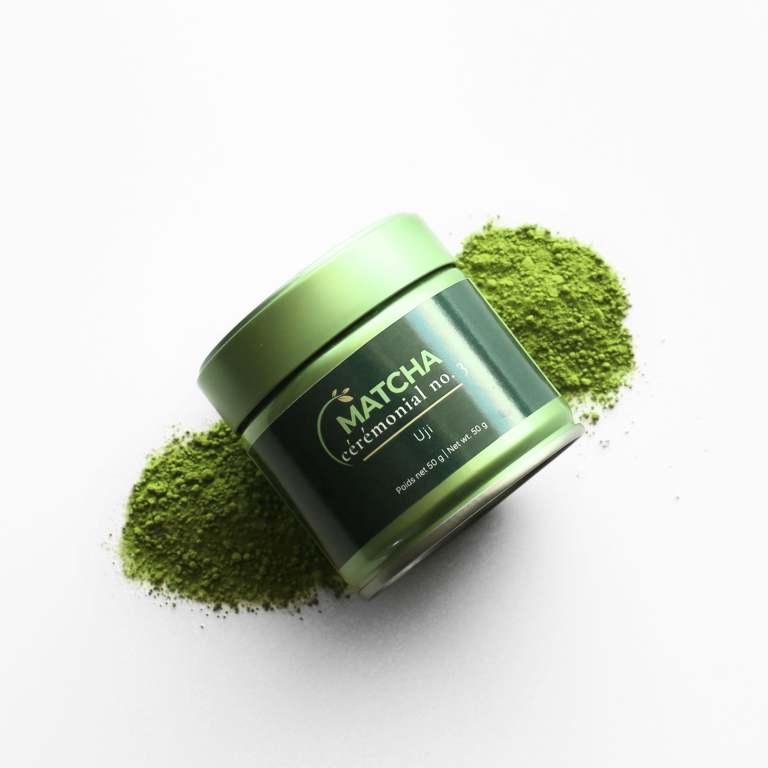
Ceremonial Matcha No.3 | Grand Cru
Okumidori from Uji, first harvest, soft and umami. Drinks beautifully on its own, and makes a delicate latte.
54,90 $
View Ceremonial No.3
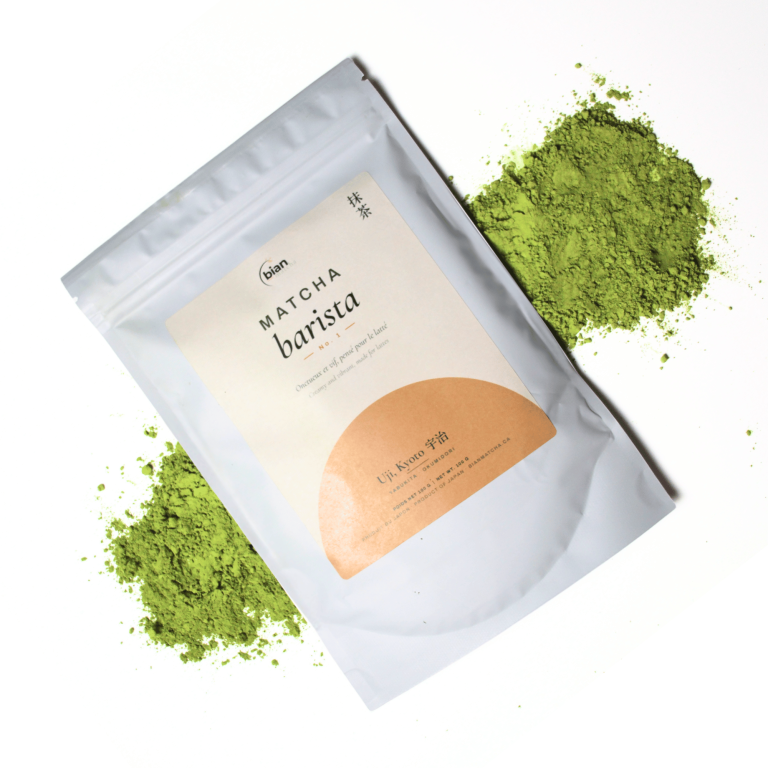
Barista Matcha No.1 | Uji Latte
A bold profile built for milk, 100 g format, about 50 lattes. Your morning latte for just over $1.
52,90 $
View Barista No.1
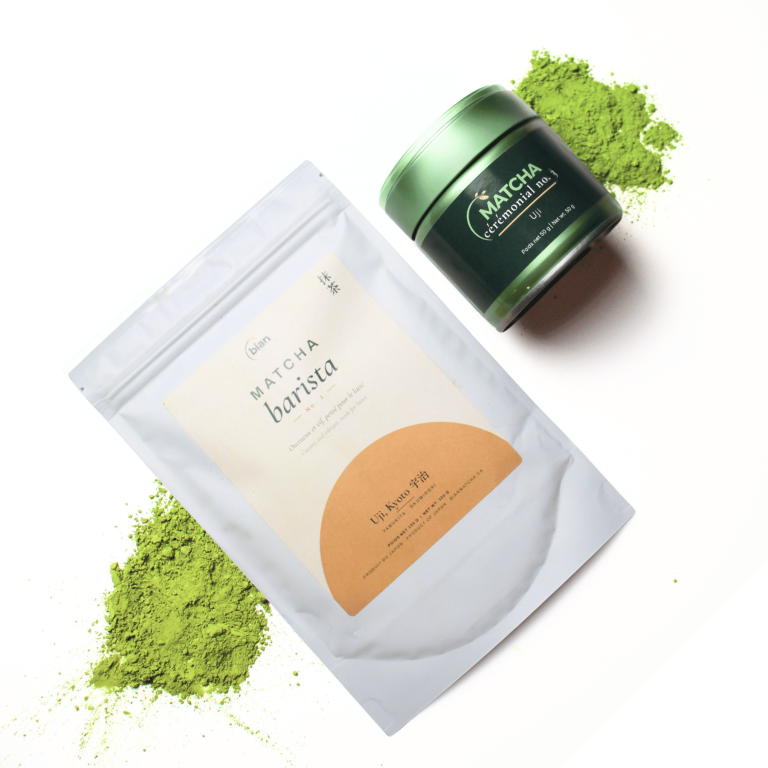
Matcha Discovery Pack | 50 g + 100 g
Ceremonial No.3 and Barista No.1 together: about 75 servings to find your ritual.
98,90 $
View the Discovery Pack
How Do You Recognize Good Matcha Before Paying?
Wherever you buy, in a Montreal shop or online, the criteria do not change. Before checking out, verify these six points:
The checklist before buying matcha
- Precise origin: “Japan” is not enough, look for the region (Uji, Nishio, Yame). A brand that knows where its leaf comes from says so.
- Harvest: the first spring harvest (ichibancha) gives the softest, richest leaves. If nothing is stated, assume a late harvest.
- Named cultivar: Okumidori, Yabukita, Samidori… An identified cultivar is a sign of serious traceability.
- Color: vivid jade green. A dull or khaki green betrays an old or lower-grade powder.
- Reasonable format: 30 to 100 g. A big economy format will oxidize before you finish it.
- Opaque, airtight container: light and air are matcha’s two enemies. The glass jar that “looks nice on the counter” is a trap.
If you want the powder and the tools in one go, our guide on which matcha kit to choose compares the formats. To dig deeper into these criteria, we have a full guide on how to recognize good matcha, an article that untangles matcha grades (ceremonial, premium, culinary) and a piece on the regions of Japanese matcha.
Buying Matcha Online: How to Judge a Shop Before Ordering?
Buying online from a specialist is not just about convenience. It is the channel where information is most complete: region of origin, harvest, cultivar, tasting notes, preparation tips. It is also where stock rotation is fastest, because the seller lives off nothing else: a specialist cannot afford to sell you an oxidized powder.
Before ordering, put the shop through the same test as the powder:
- The product page names the region and the harvest. If it is vague (“premium Japanese matcha” and nothing more), walk away.
- The photos show the actual color of the powder, not just a pretty container.
- The seller explains which matcha is for what (straight, latte, cooking) instead of selling everything as “the best”.
- There is a guarantee. A shop that refunds you if the matcha does not win you over stands behind what it sells. It is the strongest signal, because it costs dearly to whoever is bluffing.
Buying Matcha from Bian Matcha: How Does It Work?
Bian Matcha is a Quebec company. We select our matcha in Japan, in Uji, first harvest, with the cultivar named on the product page, then ship it from Quebec across the province and Canada. Concretely:
- You pick your powder from the online shop: every product page tells you exactly what you are buying (origin, harvest, cultivar, taste profile, recommended use).
- You order in a few clicks, secure payment.
- You taste it at home, at your own pace. If your matcha does not win you over, you have 14 days to get refunded, no negotiation. Buying matcha online without tasting it first takes a leap of faith: we carry that for you.
FAQ, Buying Matcha in Quebec and Canada
Where can I buy matcha in Quebec?+
At grocery stores, health food shops, Asian groceries, some cafés and online. For quality matcha (precise origin, first harvest, freshness), a specialty online shop remains the most reliable option: that is where the information is complete and stock rotation is fastest.
Where can I buy matcha in Montreal?+
At matcha bars and specialty cafés (to taste the drink), tea shops and Japanese groceries (for imported brands, mostly culinary), or online from a Quebec specialist for a documented powder (origin, harvest, cultivar) at the best price per gram. The winning combo: taste at a café, buy online.
Is grocery store matcha any good?+
It works for cooking or testing the taste, but the origin is often vague and the freshness uncertain. To drink matcha straight or in a latte, look for a precise Japanese origin, a first harvest and a jade-green color, criteria rarely found at the grocery store.
What is the best matcha in Canada?+
The best matcha is the one that checks the real criteria: a named Japanese region, first harvest, identified cultivar, jade-green color and freshness. At Bian Matcha, Ceremonial No.3 Grand Cru (Okumidori from Uji, first harvest) is built exactly on these criteria, with a 14-day money-back guarantee so you can judge for yourself.
How much does good matcha cost?+
Expect about $40 to $60 for 50 g of first-harvest Japanese ceremonial matcha, which comes to $1.60 to $2.40 per 2 g serving, and $50 to $70 for 100 g of a good latte matcha (about $1 per latte). That is far less than a matcha latte at a café ($6 to $8). Very cheap matcha almost always hides a late harvest, a blend, or an already oxidized powder.
Which matcha should I buy for lattes?+
A matcha with a bold profile, built to stay present under milk, in a format that matches your consumption. Bian Matcha’s Barista No.1 Uji Latte (100 g, about 50 lattes) is designed exactly for that. For a more delicate latte where the tea leads, Ceremonial No.3 also works very well.
Is matcha from Asian groceries worth it?+
For cooking, often yes: they carry decent Japanese brands at reasonable prices. For drinking straight or in a latte, check the date and the harvest: an imported matcha that shows neither has probably lost its freshness along the way, and you can taste it (bitterness, dull color).
Can I buy matcha online in Canada?+
Yes, and it is often the best channel for freshness and traceability. Bian Matcha ships from Quebec anywhere in Canada, with detailed product pages (origin, harvest, cultivar) and a 14-day money-back guarantee.
To keep going: our guide on choosing your matcha, the ceremonial matcha guide and our tips on how to store matcha once you have bought it.